DebtPath IQ™ screenshot tour

The Predictions tab

Your debt-free date, plus the what-if math you would never do by hand.

Overview

Predictions holds three calculators: the Out-of-Debt Forecast that dates your freedom under all four methods, the Pay-Down Simulator for a windfall, and the Consolidation Loan Calculator that models a loan before you sign it — and tells you plainly whether it helps.

Screens

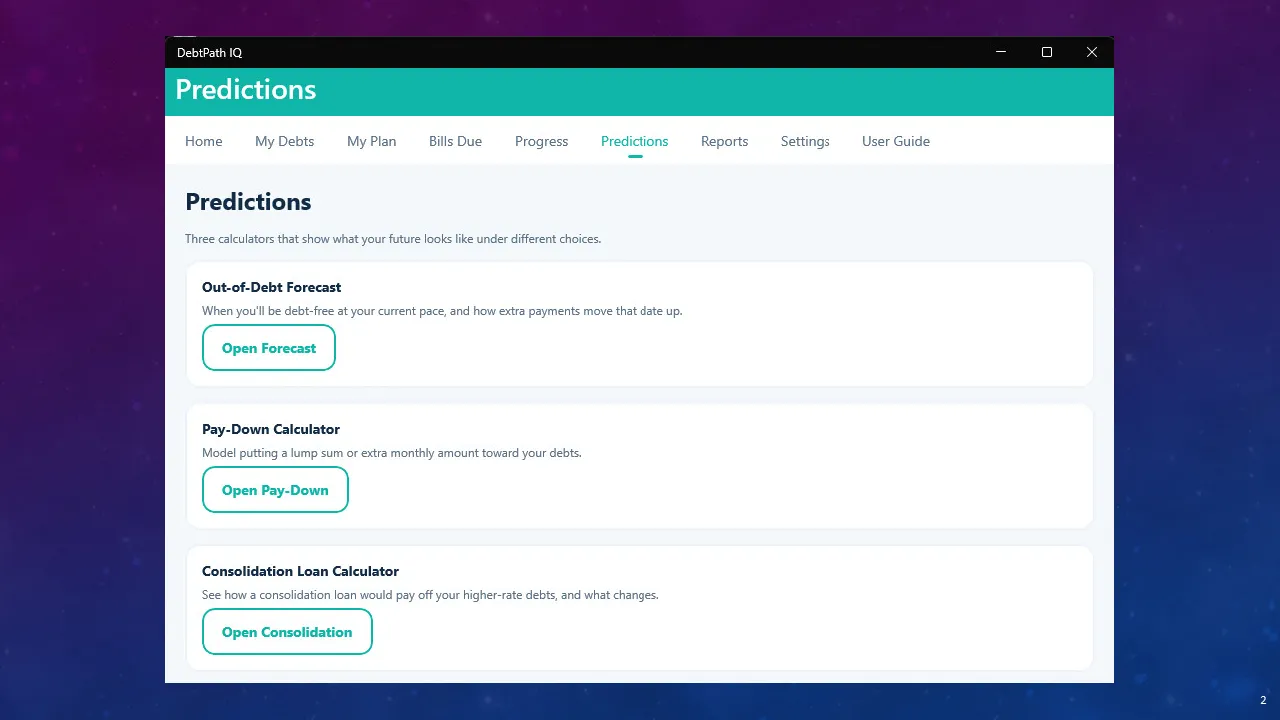
  1. The DebtPath IQ Predictions tab, described as three calculators that show what your future looks like under different choices. Three cards each hold a button: Out-of-Debt Forecast (when you will be debt-free at your current pace, and how extra payments move that date up), Pay-Down Calculator (model putting a lump sum or extra monthly amount toward your debts), and Consolidation Loan Calculator (see how a consolidation loan would pay off your higher-rate debts, and what changes).
    Three calculators

    One door, three calculators. The Out-of-Debt Forecast dates your freedom. The Pay-Down Simulator spends a windfall for you. The Consolidation Loan Calculator models a loan before you sign it. Nothing here changes your plan — these screens only show you what would happen.

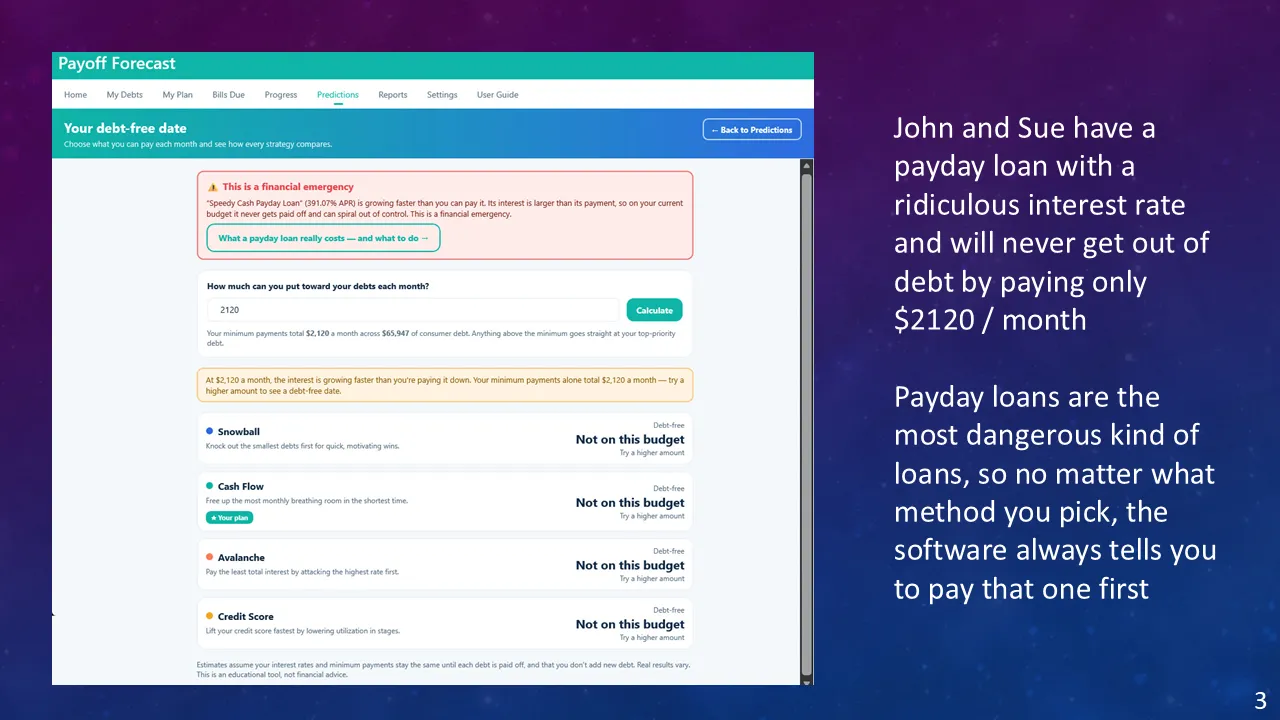
  2. The Payoff Forecast screen with a red financial-emergency panel naming the Speedy Cash Payday Loan at 391.07% APR, whose interest is larger than its payment, so on the current budget it never gets paid off. A monthly amount of $2,120 has been entered, matching minimum payments of $2,120 a month across $65,947 of consumer debt. An amber notice warns that at $2,120 a month the interest is growing faster than the balance falls and to try a higher amount. All four methods — Snowball, Cash Flow, Avalanche, and Credit Score — report “Not on this budget — try a higher amount.” Text beside the screen explains that John and Sue have a payday loan with a ridiculous interest rate and will never get out of debt paying only $2,120 a month, and that payday loans are the most dangerous kind of loan, so whichever method is chosen the software always says to pay that one first.
    When the honest answer is no

    This is the screen refusing to lie to you. Pay exactly the minimums — $2,120 a month — and the 391% payday loan’s interest outruns its own payment, so all four methods report “Not on this budget.” No invented debt-free date, no encouragement that does not survive the arithmetic. Instead the app names the emergency in red, warns that the balance is growing faster than you are paying it down, and offers to walk you through what a payday loan actually costs. Most tools would have shown you a comforting number here.

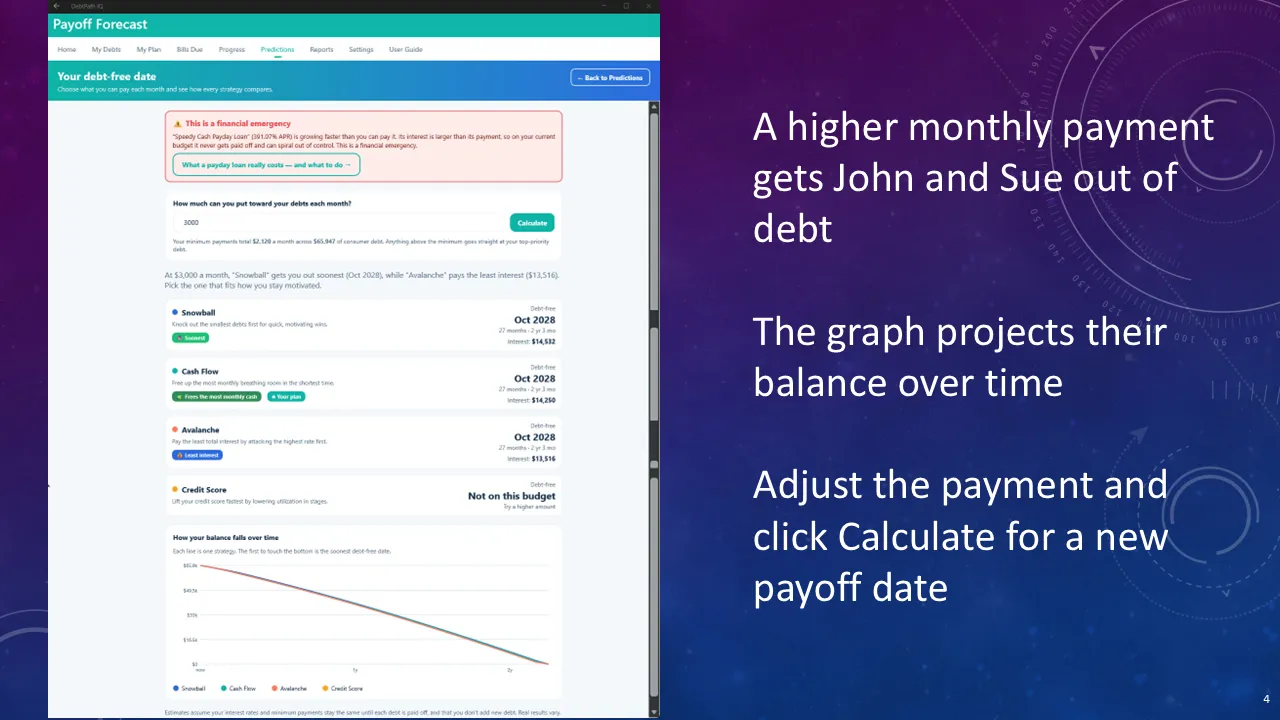
  3. The Payoff Forecast screen. A red financial-emergency panel names the Speedy Cash Payday Loan at 391.07% APR, whose interest is larger than its payment. Below, $3,000 a month has been entered against minimum payments totalling $2,120 across $65,947 of consumer debt. A summary line reports that at $3,000 a month Snowball gets you out soonest in October 2028 while Avalanche pays the least interest at $13,516. Snowball, Cash Flow, and Avalanche each show October 2028, 27 months, 2 years 3 months, with interest of $14,532, $14,250, and $13,516 and badges reading Soonest, Frees the most monthly cash and Your plan, and Least interest. Credit Score reports “Not on this budget — try a higher amount.” Beneath, a line chart titled “How your balance falls over time” plots one line per strategy falling to zero, with a footnote that estimates assume rates and payments hold and that this is an educational tool, not financial advice.
    Then raise it, and watch

    Same household, same screen, one number changed. Move from the minimums to $3,000 a month — an extra $880 — and four “Not on this budget” lines become a date: October 2028, two years and three months. That is the whole argument for finding extra money, shown rather than preached.

    The badges then do the choosing for you — Snowball soonest, Avalanche cheapest at $13,516 of interest, Cash Flow freeing the most monthly room. Credit Score still reads “Not on this budget,” because that method needs more room than $3,000 gives it, and the app says so instead of pretending. The chart below draws one falling line per method, so the first to touch the bottom is the fastest way out.

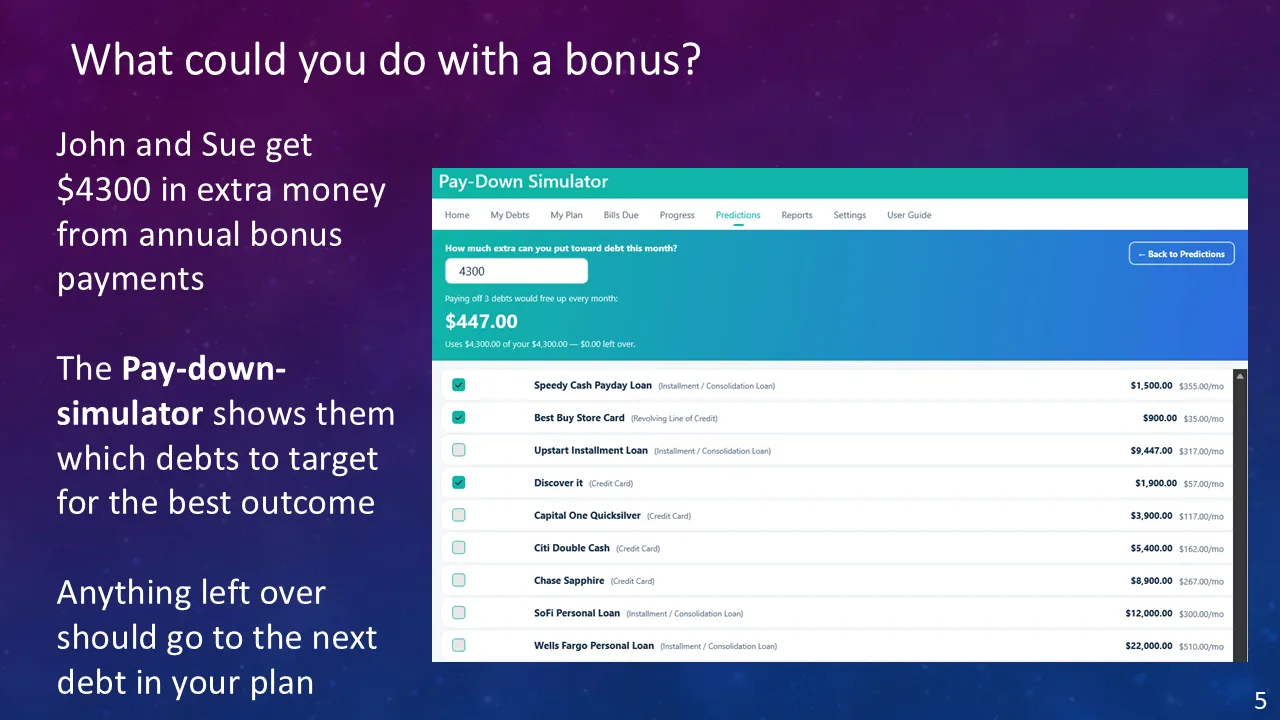
  4. Slide headed “What could you do with a bonus?” with text explaining that John and Sue get $4,300 in extra money from annual bonus payments, that the Pay-Down Simulator shows them which debts to target for the best outcome, and that anything left over should go to the next debt in the plan. The Pay-Down Simulator screen shows $4,300 entered as extra money available this month and reports that paying off 3 debts would free up $447.00 every month, using $4,300.00 of the $4,300.00 with $0.00 left over. A checklist of all nine debts follows with the Speedy Cash Payday Loan at $1,500.00, the Best Buy Store Card at $900.00, and Discover it at $1,900.00 ticked, each row showing its balance and monthly payment.
    Spending a windfall well

    A tax refund, a bonus, an inheritance — this screen decides where it should land. Enter the amount and DebtPath IQ™ ticks the debts that clear completely, then tells you the thing that actually matters: how much monthly payment you just bought back. Here an annual bonus of $4,300 wipes out three debts and frees $447 every single month from then on. Note which three it picked — the payday loan first, then the two small balances the money can finish off outright, rather than making a dent in something large.

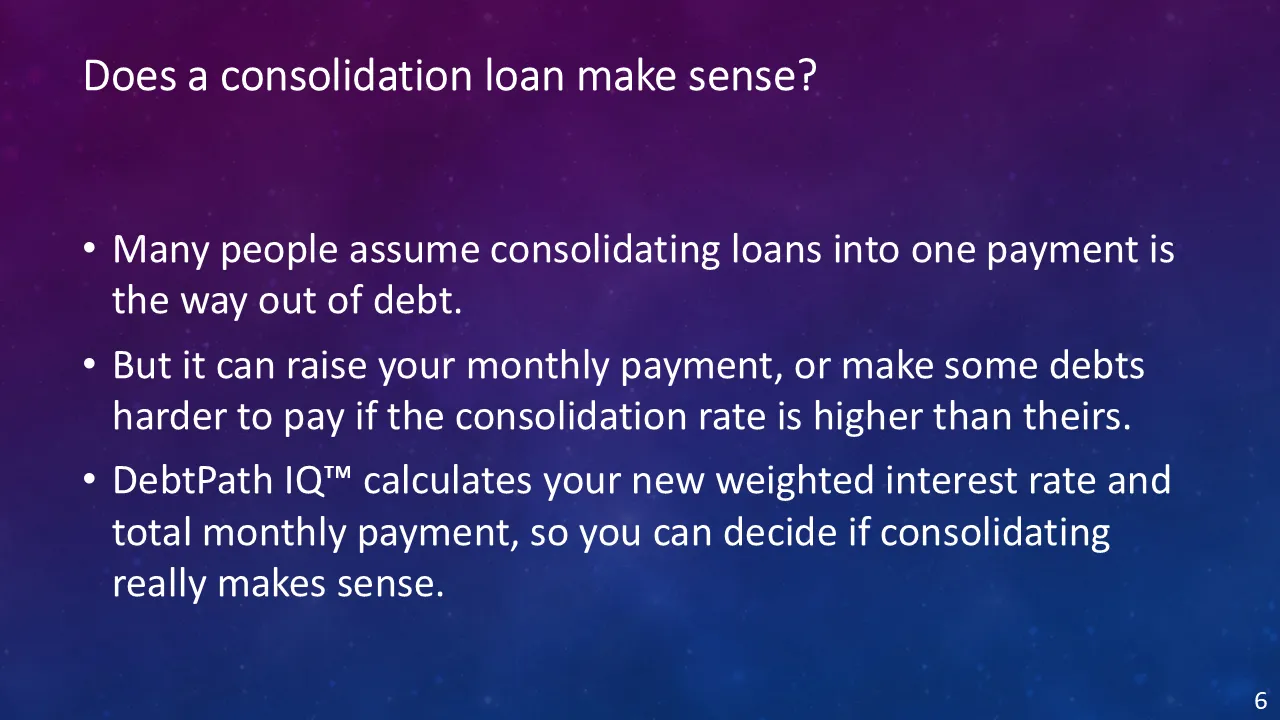
  5. A slide headed “Does a consolidation loan make sense?” with three points: many people assume consolidating loans into one payment is the way out of debt; it can raise your monthly payment, or make some debts harder to pay if the consolidation rate is higher than theirs; and DebtPath IQ calculates your new weighted interest rate and total monthly payment so you can decide whether consolidating really makes sense.
    The question behind consolidation

    Consolidation is the most oversold idea in debt. One payment feels simpler, so people sign — and sometimes end up paying more each month, or move a cheap debt onto a pricier loan. The only way to know is to run your own numbers, which is exactly what the next screen does.

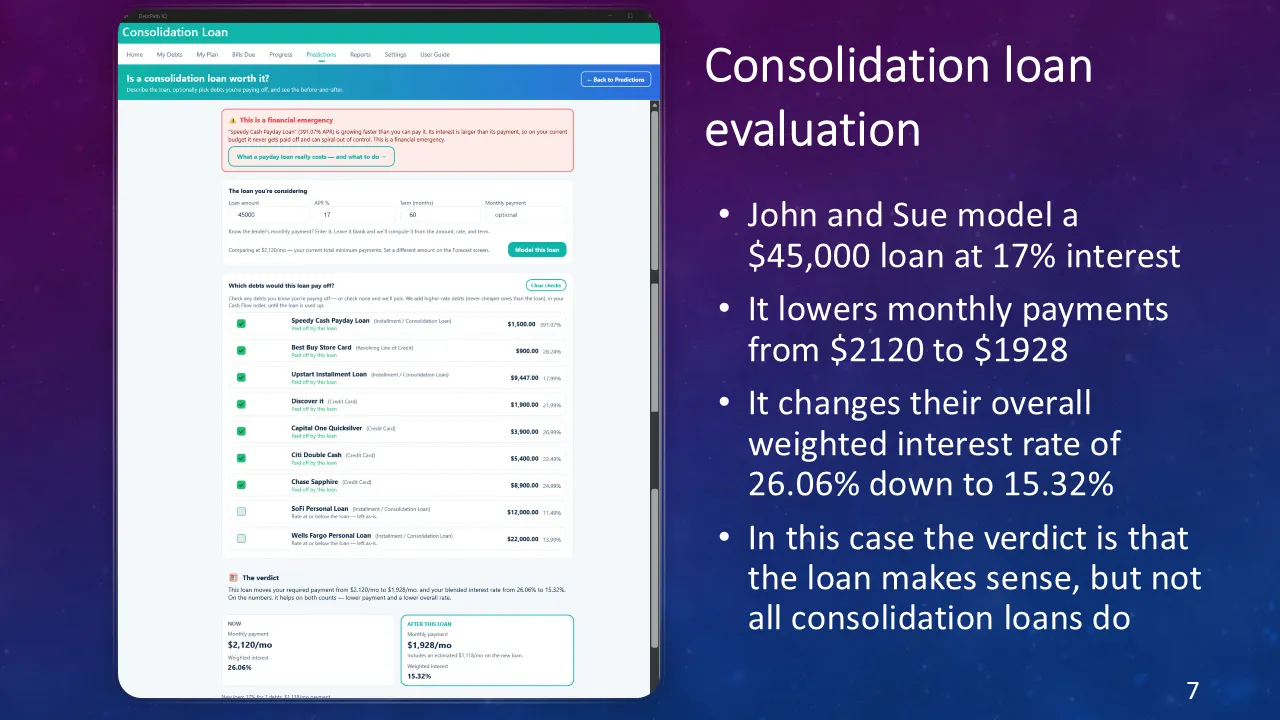
  6. Slide titled “Consolidation loan evaluation.” The Consolidation Loan screen shows a $45,000 loan at 17% APR over 60 months being compared against $2,120 a month of current minimum payments. A checklist ticks seven debts as paid off by this loan — Speedy Cash Payday Loan, Best Buy Store Card, Upstart Installment Loan, Discover it, Capital One Quicksilver, Citi Double Cash, and Chase Sapphire — while SoFi Personal Loan at 11.49% and Wells Fargo Personal Loan at 13.99% are left unticked and marked “Rate at or below the loan — left as-is.” The verdict states the loan moves the required payment from $2,120 a month to $1,928 and the blended interest rate from 26.06% to 15.32%, helping on both counts. Bullet points beside the screen note that John and Sue model a $45,000 loan at 17% interest, that it lowers monthly payments from $2,120 to $1,928, that it changes their weighted rate from 26.06% down to 15.32%, and that in this case the loan makes sense, but not all consolidation loans do.
    The whole evaluation, top to bottom

    One screen answers the whole question. Type in what the lender is offering — $45,000 at 17% over 60 months — and DebtPath IQ™ works out the payment, picks which debts to clear, and delivers a verdict: $2,120 a month at 26.06% becomes $1,928 at 15.32%. Lower on both counts, so this loan helps.

    The reasoning is on the page too. Seven debts get paid off. SoFi at 11.49% and Wells Fargo at 13.99% are deliberately left alone — both already cost less than the 17% loan, and moving cheap debt onto an expensive loan is the classic consolidation mistake. The app will not do it to you. And read the last line of Robert’s summary carefully: this loan makes sense — not all of them do. Run yours before you sign.

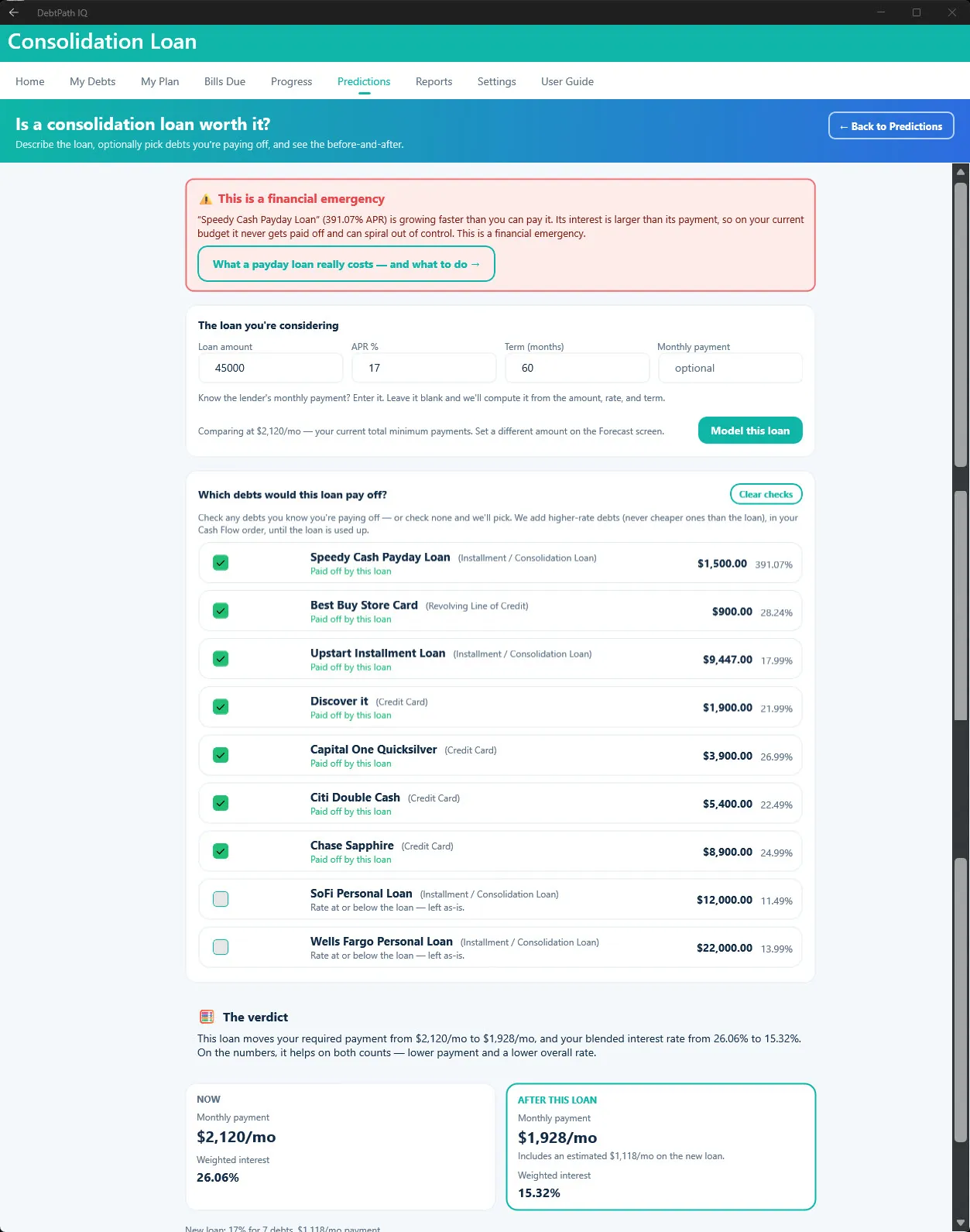
  7. The full Consolidation Loan screen captured end to end at readable size: the red payday-loan emergency panel, the loan form showing $45,000 at 17% APR over 60 months compared against $2,120 a month of minimum payments, the complete nine-debt checklist with seven ticked and marked “Paid off by this loan” and SoFi and Wells Fargo unticked and marked “Rate at or below the loan — left as-is,” and the verdict panels comparing NOW at $2,120 a month and 26.06% weighted interest against AFTER THIS LOAN at $1,928 a month and 15.32%, including an estimated $1,118 a month on the new loan.
    The report, full size

    The consolidation screen runs longer than a slide can hold, so here it is end to end at full size. Open this one to read it properly. Every debt shows its own rate beside it, each ticked row says “Paid off by this loan” in plain words, and the two untouched rows explain themselves — “Rate at or below the loan — left as-is.” This is the page you would want in front of you before signing anything a lender puts on the table.

Ready to see these screens with your own numbers in them?

$49.99 once — the introductory price through November 30, 2026, then $79.99. On sale now for Windows 10 and 11; the Mac version goes on sale October 1, 2026. Your data never leaves your computer.

Get DebtPath IQ™ — $49.99